
Accumulation

When we wash our hair, we don’t expect the shampoo to do all the work. We know the wash is one part shampoo, one part our effort. Without effort, the shampoo is just a waste, without the shampoo, our efforts are for naught. We understand that we play a very significant role in facilitating our own cleanliness.
When it comes to our healing though, we often forget this important fact. We expect a pill or herb to do the heavy lifting, with little to no cooperation on our part. Yet if we can’t get our hair clean without a little elbow grease, how are we supposed to lower our blood pressure, curb our anxiety, or deal with our acid reflux without expecting, in the very least, the same effort on our part as washing our hair?
Ayurveda, part of my cultural heritage as a Rroma person, is an ancient system of medicine, serving living beings since time immemorial. Ayurveda refers to the concept of disease as Kriyakala. Kriyakala is a Sanskrit term, comprising the words Kriya and Kala. Kriya means the choice in treatment (medicine, food, and lifestyle adjustments) used to improve the bodily imbalance, and Kala refers to the stage of progress of a disease1.
Kriyakala has 6 stages2. Only the last two stages are considered ‘disease’ by modern scientific standards. The rest fall under the umbrella of ‘preventive medicine’.
From an Ayurvedic perspective, a person’s ‘weird’ bodily idiosyncrasies such as recurring noon time headaches, intermittent summer indigestion, general irritability, and rosacea are all considered important information for proper disease diagnosis. Modern science considers these symptoms unrelated and often recommends nothing more than over the counter pain relievers or topical creams, missing the important beginning stages of disease that Ayurveda identifies; the first of the six stages being Sanchaya, or accumulation2.
I’ve done a lot of thinking about Sanchaya in the last several months. Sanchaya – accumulation, collection – is the story of seemingly unrelated actions that are intrinsically connected, together moving toward a larger purpose. According to Ayurveda, a person’s symptoms are actually an organized warning system that point to a specific underlying systemic imbalance. Think of it as a disturbance in the ‘force’. If left untreated, this disturbance will continue to progress down the line of the Ayurvedic stages of disease, finally landing on symptoms loud enough that Western Medicine can recognize, diagnose, and attempt to treat.
We’re very good at some methods of accumulation in modern day society. This sentiment is summarized best in the immortal words of legendary hip hop artist Biggie Smalls when he said: ‘Mo Money, Mo Problems’3. Biggie didn’t say, ‘Money, Problems’, He said ‘Mo’ (aka ‘more’). And he said it twice. He understood that our drive to accumulate is a given. He also understood that what we accumulate is as important as our need to accumulate. And what we’ve been accumulating is problematic at best. Though we think we’re just collecting a bigger paycheck and a better car, it looks like what we’ve been overwhelmingly successful at acquiring is stress – over 55 million USers currently experience mental illness4 and almost half of us have hypertension5. Biggie wasn’t exaggerating when he talked about ‘mo problems’.

Join Jennileen’s next live online Albuquerque Herbalism class:
All Things Diabetes: A Holistic Perspective, September 2024
The numbers point to a very obvious and concrete fact: we are overachievers when it comes to both the drive to accumulate and what we accumulate. In our drive to accumulate, we can recognize how tenacious, capable, and passionate we really are. The issue is most of this effort is misdirected. We often think we are lazy, unmotivated, unwilling, and unable to take a leading role in our healing. We somehow believe that taking care of ourselves is too complicated, too strenuous, too time consuming, and too overwhelming. In our fervor to accumulate more, we walk around completely blind to the power we hold. When we realize that our innate ability to accumulate is our best asset for our ongoing health and well being, that’s when the magic truly happens.
The reality is we are making an effort by not making an effort. We are doing a dance with the first stage of disease always; we are accumulating. Alok Kanojia, MD MPH, is a Harvard-trained psychiatrist specializing in integrative views on modern mental health. In order to shift how we think about taking charge of our health and wellness, Dr. Kanojia asserts that we need to understand that at the core we have no control over outcomes. We are in charge of this day only, nothing more. From this perspective, he asks us to consider this: what if we treated our lives, specifically the next 24 hours, as though they were borrowed from someone we deeply love6. If we step into a cherished one’s life, and live it for this one day, it’s likely that we will leave things better than we found them. We bypass our inability to do for ourselves and instead harness our willingness to do for others.
The last several months I have not only been thinking about Sanchaya but making an effort to harness both my drive to accumulate and what I’m accumulating very intentionally. Instead of letting my bad habits get the best of me, I decided to give myself time and space to untangle some harmful perspectives that were making a mess of my life. I spent a month in a Buddhist monastery and another two months in Okinawa, Japan, very deliberately changing things up. I centered my days around practicing mindfulness and detachment with love, actively reprogramming myself to love me and to take the time to regard my deepening connection to the earth and the universal force that creates all life. This journey was a huge gift I gave to myself and could not have happened without the sacrifice of my family and my wallet, as well as the kindness of the practitioners of the Plum Village Buddhist tradition and the people of Okinawa.
In Ayurveda, Sanchaya is mostly talked about in the context of disease manifestation. In these last several months, my mind wandered constantly to the idea of what I am amassing, collecting, and accumulating in my life. If we consider accumulation to be analogous with growth (the directions of sideways, forwards, or backwards all count), we realize that accumulation is inevitable because that is the nature of existence. This is a fact none of us can control. As I live and breathe my effort (this includes what I think of as ‘lack of effort‘) accumulates ‘something’ in my life. What I do or don’t do, how I think or don’t think all add up to something. And it turns out we have a lot of control over what that ‘something’ is.
Let’s look at the definition of Sanchaya again:
“Sanchaya–accumulation, collection–is the story of seemingly unrelated actions that are intrinsically connected, together moving toward a larger purpose.”
If we want to accumulate health and well-being in our lives, we need to go back to the lessons learned regarding washing our hair. We need to do our part, do it well, and most importantly, do it consistently. Otherwise we walk around a smelly and oily mess.
Self love is hard for many of us. Me included. It’s much easier for me to go out of my way for someone else in ways I would never for myself. This has unsurprisingly caused a lot of tension in my life, as how are we to expect others to treat us well or with regard if we won’t or can’t.

So let’s go back to Dr. Kanojia again.
If we live as though we are borrowing our lives from someone we cherish, we give ourselves permission to go the extra mile. We find the strength and enthusiasm to do the ‘little things’ that are often a struggle like eating our veggies or drinking medicinal teas. Adopting this sentiment allows us to be the ultimate gift givers. We can finally decide to do for ourselves because we are contributing to the happiness and health of someone we love. As we hold this perspective daily, we grow stronger mentally and physically. Our bellies fill with love cause we are nurturing our tired and broken spirits with thoughtful actions and sweet nothings. We’ve changed both our drive to accumulate and what we’re accumulating. The ultimate goal.
So much of herbal medicine in the context of modern society is cold, contractual, and conditional i.e. ‘I will only take x herb to gain y results’. This is not a mistake, as capitalism is built on contracts, money, and extraction. Yet most ‘herbal medicine’ was born out of traditional lineages that are snuggled in with the stories of people and land. This is the heart of what the term ‘integrative’ really speaks to. Herbal medicine formed alongside humanity, the plants and humans sang to one another, danced together during wind, rain, sun, and starry nights, gave thanks together for the miracle of being alive. This beautiful, nuanced, and gorgeous conversation was how both groups flourished exponentially. Accumulation at its best.
Yet, in modern day capitalism, ‘herbalism’ has been separated from the land and lineages it was birthed from. It has been repackaged to mimic the Western medical establishment – based in allopathy – which separates the body from the mind, spirit, and ancestors and looks for quick and aggressive outcomes based in laboratory science. These allopathic healing methods have become the dominant story of healing in the modern day world, even though the World Health Organization estimates that 40-80% of the world’s population depends on traditional medicine as a source for health and healing7.
These numbers help us recognize the truth: many of us are still actively involved in our traditional medicines or are currently relearning these ways. We know this as a very concrete reality here in New Mexico, where many of us still retain ties to traditional medicines from our tribal affiliations or through avenues such as Curanderismo. As we continue to dig deep into our healing lineages, we can choose to adopt the mindset of positive accumulation, of understanding that we can treat today as a collection of gifts lovingly wrapped for our future selves and act accordingly.
Disease is harsh. At its core it’s cold, aloof, selfish, and high maintenance. We cannot go about our healing with the same attitudes and expect different results. No one ever gained confidence by being called stupid. We grow when we are treated with tenderness, patience, and love, and are given support to accumulate better habits and behaviors. If we are to really lean into the lessons of herbal medicine, we have to understand that inherent in its varied ideologies are the accumulated stories of slowness, softness, gentleness, tenderness, deep kindness, love, and above all, interconnectedness.
There were many times in the last several months that I did not want to wake early and start my day with good habits that foster my health and wellbeing. For me, this comes in the form of prayer, meditation, exercise, and being with nature. I felt lazy, unmotivated, and discouraged. Luckily the time I carved out for myself was at such an emotional and financial cost that that was a good motivator lol. I began to think more and more about my future self. My Tomorrow Self that my Today Self will never know. She feels cherished when I invest in her. Making decisions that are good for me began to feel like beautiful little actions I could gift my Tomorrow Self instead of isolated choices. I could see all my individual choices woven into a dynamic tapestry. I was finally beginning to actively love myself. As a Rroma woman, I was raised to think of the collective over self. I was raised to think of survival at all costs. Growing up assimilated and disconnected, there was no room for softness and gentleness; there was only harshness on top of a constant barrage of external and internal gaslighting. That’s why they say love and loving yourself is a truly revolutionary act. It goes against everything that has attempted to annihilate and disappear whole lineages.

Yerba Mansa, Anemopsis californica
A huge overlooked part of modern herbal medicine are these ‘softer’ understandings. We take from the medicine without remembering what every one of our ancestors knew (for some of us, we have to dig far back to find this understanding but I assure you, it’s there). You can’t get something for nothing. In the context of herbal medicine, this ‘something’ is a relationship. A relationship filled with regard and tenderness toward ourselves and with the medicine.
There have been countless recent studies that demonstrate that being in relationship with nature (i.e. herbal medicines cause basically every plant out there offers some kind of medicine to people directly or indirectly) can foster deep physical, psychological, and emotional impacts. Shinrin-yoku, also known as Forest Bathing, is a contemporary example of humans acknowledging the benefits of interconnectedness. Started in the 1980s in Japan to tackle stress among the nation’s men, it has proven beneficial for all populations. Studies show when we spend time with nature, our heart rates steady, our cortisol and blood glucose levels return to normal, our immune and respiratory systems improve, our moods lift, we have a deeper sense of peace, and we sleep better8, 9. As Mohawk elder Tom Porter says, “Ultimately, nature will do the teaching” 10. Large old growth forests are now being preserved in Japan so people can continue their Shinrin-yoku activities. By investing in our own health in a relational way, we also nurture the health of the world around us.
I love Yerba Mansa (Anemopsis californica). I am fascinated by its long history, the way it has intermingled with the people indigenous to the land called New Mexico. Many people use the roots and aerial parts to heal the lungs and lymphatic system during times of sickness. Currently, Yerba Mansa is on the At-Risk list, as the boggy and wet ecosystem that it thrives in along the Rio Grande is rapidly drying up11 (this is, in my opinion, mostly due to humans not thinking about their Tomorrow Selves).
Lately, there’s been some tension about harvesting Yerba Mansa, as there is less of it to go around and more of us who want to use it. Largely lost in this conversation about its use or misuse is the very simple and beautiful way we can contribute to both our own health and our currently fractured relationship with this plant: we can just go be with it.
Plenty of our ancestors sat amidst her peppery smelling flowers as they bloomed in the spring or laid among her dead leaves in the late fall and winter. If Yerba Mansa isn’t part of your people’s story, know that another plant is. We humans have lived alongside plants and depended on them since time immemorial. We can assume our forebears cried next to, laughed alongside, and tearfully asked for help from the plants they slept, hunted, and bathed near.
Scientific data confirms that plants are interconnected and talk to one another12. Plants also release particular chemical constituents to deter or attract other living beings13. If our peoples and cultures have a long standing relationship with a particular plant, it is only because we’ve been invited to love it, pick it, and utilize its gifts. This invitation exists because we have approached plants historically with a willingness to roll up our sleeves and help the plant literally flourish. We have safeguarded their existence and they have safeguarded ours.
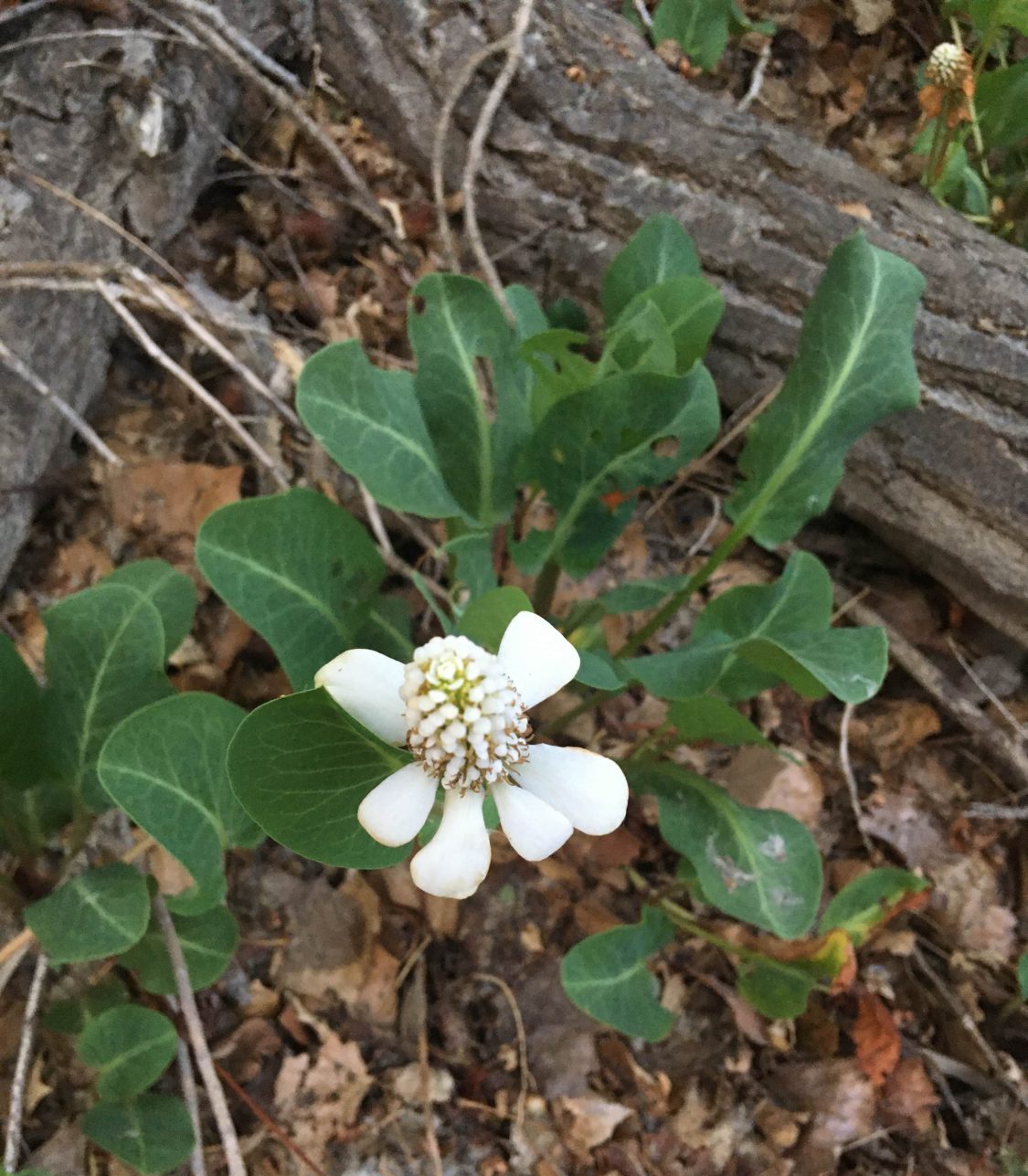
Yerba Mansa, Anemopsis californica
So I leave this challenge here for all of us: I challenge us to start positively accumulating today. The seemingly unrelated actions of relaxedly sipping a cup of tea while watching the rain, getting a massage, eating breakfast, sitting under a tree, and tending to our houseplants are intrinsically connected, together moving toward the larger purpose of the happiness, health, and wellbeing of our Tomorrow Selves. I challenge us to put tenderness, love, and kindness in the center of any offerings we make to our Tomorrow Selves. I challenge us to spend time with nature. I specifically invite us to go to the Bosque, find a patch of Yerba Mansa, and sit down among her leaves. Do not worry about bugs and dirt. Pick or harvest none of her lovely aerial parts or roots. Instead feel her, smell her, sit with her, and be quiet enough to hear her song. I challenge us to keep doing this, to lovingly accumulate deep and lasting relationships with the plants of the Bosque, the forests, and the meadows here in New Mexico. We cannot achieve true health without this very important bond. Our lives are interconnected with nature and have been since the dawn of humanity. As we build our days around gifting our Tomorrow Selves teas, baths, slow walks, meditation, and vegetables, we begin to accumulate an even deeper understanding of how these offerings are single words that together create the most melodious and gorgeous poem. We find that we accumulate more softness, love, tenderness and strength. And that is how true and lasting health flourishes.
From my heart to yours….
Jennileen Joseph is a clinical herbalist at Satimos Holistic Health. Follow her on social media @sastimosholistichealth to get up to date information on course offerings, as well as to book a plant medicine consult or purchase a custom herbal formula.
References
1: Kriyakala
https://jaims.in/jaims/article/view/1191
2: Six stages of disease according to Ayurveda
‘In Ayurveda, there are six stages of disease: Sanchaya (accumulation), Prakopa (aggravation), Prasara (dissemination), Sthana Samshraya (localization), Vyakti (disruption), and Bheda (manifestation). There are no symptoms or vague complaints during the first four stages. If a patient comes to a doctor during the first four stages, the patient is often labeled a hypochondriac, as modern medicine frequently does not have screening techniques to identify early stages of disease.’
3: Biggie Smalls, ‘Mo Money, Mo Problems’ https://www.youtube.com/watch?v=ss142Aix2Bo
4: Mental health statistics (https://mhanational.org/issues/state-mental-health-america)
5: Hypertension in the US (https://www.cdc.gov/bloodpressure/facts.htm)
6: Dr. Kanojia, ‘Why it’s so hard to be consistent’
https://youtu.be/ZKNRXuZWYYg?si=gwOWrz_P-ukKaKh1
7: According to 2012 data, almost half the population in many industrialized countries now regularly uses some form of T&CM (United States, 42%; Australia, 48%; France, 49%; Canada, 70%); considerable use of some form of T&CM exists in many other countries, such as Chile (71%), Colombia (40%) and up to 80% in some African countries.
https://www.who.int/news-room/questions-and-answers/item/traditional-medicine
8: History and studies regarding efficacy of Shinrin-yoku
https://www.ncbi.nlm.nih.gov/pmc/articles/PMC2793346/
9: Shinrin-yoku (https://www.ncbi.nlm.nih.gov/pmc/articles/PMC5580555/)
10: Meditations with Native American Elders: The Four Seasons, www.coyhispublishing.com Tom Porter: https://www.seedsofwisdom.earth/elder/tom-porter/
Yerba mansa scientifically proven to prevent lung infections
https://www.ncbi.nlm.nih.gov/pmc/articles/PMC4586282/
12: Chapter 2 in ‘The Hidden Life of Trees: What They Feel, How They Communicate – Discoveries from a Secret World’ by Peter Wohlleben
13: Chapter 2 in ‘The Hidden Life of Trees: What They Feel, How They Communicate – Discoveries from a Secret World’ by Peter Wohlleben


