
Dreaming with Plants
Loss and grief are an inevitable part of being human, and we all will experience both in our lifetimes. Modern westernized culture doesn’t offer many tools to support us when we are facing loss, whether it by death of a loved one, a pet, loss of a job, a relationship, or loss of one’s health. After a major loss, like a death of a family member, at most we are given a few weeks of bereavement time and then expected to be ready to go back to work and back to “normal”. Grief can be overwhelming, exhausting and the process to recover from a major loss can take a long time.
I am an herbalist and a dreamer. I have been fascinated by my dreams since I was a young girl. I can still vividly remember a dream about my family I had when I was about 8 years old. This nightmarish dream startled me, and I remember riding my bike to the local library to check out a book about dreams. This dream sparked my lifelong interest in dreams and today I consider my dreams to be a major source of guidance and healing.
My dreams have informed major decisions at different crossroads of my life. For example, a dream I had about a circle of people engaging in a ceremony affirmed my choice to attend a particular program in graduate school. I had prayed the night before this dream came for a sign about whether this graduate program was the right one for me. Entering this graduate program not only turned out to be one of the best decisions of my life, but also introduced me to a ceremonial community (like in the dream) and a circle of life-long friends.
I had been keeping dream journals for decades, but it wasn’t until I went to graduate school that I received any formal teachings about how to work with dreams. In graduate school I was blessed to meet and be mentored by dream elders. One of my dream teachers had an academic background in consciousness studies and a Jungian approach to dreamwork. Others of my dream teachers were indigenous elders who shared about dreams from their cultural perspective. Both western psychological and indigenous perspectives inform my approach to dreams. As an herbalist for over thirty years, a major part of my journey as a plant person and a dreamer has been to explore the ways in which the world of plants and the world of dreams intersect.
Over years of working with my own dreams I have paid close attention to the ways plants show up in my dreams and have also observed the ways plants influence my dream state. I also have facilitated many dream sharing circles in which I had the opportunity to listen to and witness the dreams of other people, many of them my herbal students. Through the process of observing both my dreams and other people’s dreams, I have noticed patterns in which the herb world and the dream world interact with one another. Plants can weave into our dream state in many ways. Sometimes plants in dreams can be prescriptive, meaning that they are suggesting that this is an herb we need may to take in waking life. Plants in dreams can be teachers and convey messages and give direct healing advice. Other times in dreams, plants can bless us with a healing or cleanse us with a limpia.
If we engage with plants in the waking state before we go to sleep, or place plants in our sleeping space they can also influence the quality and content of our dreams. These dream-inducing plants are called oneirogens and include plants like mugwort (Artemisia vulgaris), African Dream Root (Silene capensis), and pericón (Tagetes lucida). While these plants are well-known for influencing our dreams, I have discovered in my experimentation with dreaming with plants that ALL plants can affect our dreams. One of my dream maestros Sergio Magaña teaches that all things have an energetic dream body, or what in the Mexica tradition is called a nahual. Not only do living beings like animals and plants have a nahual, but so do beings that western science may consider to be inanimate like rocks, stars, the sun, the moon and even the earth. Therefore, herbalists and plant loving people can dream with any plant to connect with its energetic body/nahual so that we can learn more about its energy, personality and healing qualities.

Mullein rosette (Verbascum thapsus) (see Dream Teachings below)
Plant Communication
The language of plants is quiet and subtle, hard to hear over the roar of technological noise that we are bombarded with in today’s modern world. Plants are sessile, which means they don’t move around like humans and other animals. Like many other living beings, plants don’t communicate through sound and cannot bark or squawk or buzz or moo.
As Robin Wall Kimmerer writes: “Plants tell their story not by what they say but by what they do.”[I] To learn the language of plants requires a practice of observation. Where does it grow? Does it like shade or sun? What color and shape are the flowers? What does it smell like? What pollinators does it attract? One way to practice listening to plants is to engage in a plant meditation. This means sitting quietly with the plant and observing it. Relax your body, clear your mind and take a deep breath. Focus on breathing with the plant. With each breath we take on planet earth, we can thank our plant relatives for generously supplying us with the oxygen we need for breath and life. As you breath with the plant, take time to notice the shape, color, texture and personality of the plant. Open your mind to the subtle ways the plant may be communicating with you and take time to journal what you observe.
We can also do a plant meditation by taking a few drops, or spirit dose of the tincture and notice the way it affects us. What does it taste like? Is it warming or cooling? Where do you feel the plant’s energy in your body? Do images, words, memories come to mind when you mediate with this plant? We also learn the language of medicinal plants by engaging with them as food and medicine, growing them in the garden, or studying them in their natural environments.
Plants also communicate with us is through dreams. Perhaps it is because in the sleeping state we are quiet and receptive to hearing their voices. When a plant shows up in a dream, it is important to take time to understand its message. It’s presence in a dream may be symbolic but it may also be instructive or healing.
Join Atava’s Live Online Classes: Plants as Doorways to Ancestral Consciousness November 16, 2024 + Flower Essences for Healing, Transformation, & Collective Evolution April 5, 2025
Prescriptive Messages from Plant Dreams
Sometimes when a medicinal plant appears in our dream, it is a signal for us to take this herbal remedy. A few years ago, I had series of dreams about elderberry. Elderberry is a medicinal herb I know very well and for many years I tended to an elderberry tree in my garden. Each summer I would harvest the ripe blue berries to make elderberry cordial. This elderberry tree produced so many berries that I would take them to my herbal classes so that I could share them with my students.
As an herb, elderberry is strongly anti-viral. It helps protect our cell walls against viral attack. Elderberry is a great remedy for preventing and treating the common cold and a host of other common respiratory infections. When I had my series of elderberry dreams, I noticed them with curiosity. However, even though I was a seasoned dreamer, I did not heed the prescriptive advice of the dream and failed to take any of my elderberry cordial. At the time, I didn’t feel sick and it didn’t occur to me to take it.
A few days after I had the elderberry dream, I came down with a cold. My dream body knew I had been or would be exposed to a virus and had sent me a warning. The warning was subtle; there were no words, only images of elderberries. If I had started to take the elderberry cordial when I had the first elderberry dream, chances are I would have given my immune system the boost I needed to stave off the cold. But instead, I got sick and learned a valuable lesson about prescriptive plant messages in dreams.
Pay close attention to the herbs or foods that show up in your dreams, especially if they are plants that you have worked with as medicines in your waking life. When one of your herbal allies (plants we have already built a relationship with) shows up in a dream, and you know about the dosage and safety profile of the plant, you may consider taking it as a medicine or eating it as a food.
An herbal remedy can beckon you in your dream even if you don’t have a waking knowledge about the herb. A friend of mine from dream group once told the group that one morning she had simply awakened with a word in her mind. When she had this dream she had been struggling with chronic allergies & asthma and was getting sick a lot.
My friend is a woman of Chinese descent, and recognized the word to be in the Chinese language. As she did further research on this word, she discovered it was the name for a Chinese medicinal herb. After talking to her acupuncturist, she realized that this herb was the perfect remedy for her current respiratory condition. In this way, the wisdom of the plant and also most likely her own ancestors guided her to the remedy to help her regain her physical health.
If an unfamiliar plant shows up in your dream, first consult to make sure that it is safe for you to eat or to ingest. Take some time to learn about the healing qualities of the plant, the safe dosage, and if there are any contraindications or interactions with medications you are taking. If the plant is toxic or otherwise contraindicated for you to take as a medicine, you can choose to work with it energetically. Research to see if this plant is used as a flower essence or homeopathic remedy, both which are safe ways to interact with toxic plants.
However, you don’t need to ingest a plant to receive its healing. I often recommend to my clients and students to spend time with the plants they dream about. If you dream of an oak tree, go outside and find an oak tree to sit and meditate with. You can also simply put a piece of the plant on your altar or carry a bit of it in a pouch or medicine bag that you wear on your body, or even print out a photo of the plant and place it on your altar.

Mullein flowering stalks, Verbascum thapsus
Dream Teachings from Plants
In many traditional cultures, healers would receive healing knowledge in the dream state. Recently I was attending the summer curanderismo class at the University of New Mexico where Maestro Laurencio Lopez from Oaxaca, Mexico shared about the ways his dreams guided his path as a curandero, or traditional Mexican healer. In his dreams Maestro Laurencio was shown books that contained vast knowledge of healing, and this knowledge over time trained him to be a curandero. Among the Pomo people of what is now called Northern California, there is a great tradition of Pomo dream healers. One of these dream healers was a renowned Pomo medicine woman named Mable MacKay. During her childhood, Mable began being instructed by a spirit in her dreams. The spirit in her dreams taught Mable how to heal with plants, ceremonies and songs. Mable became a great medicine woman, and her story was documented by Pomo author Greg Sarris in the book Mable McKay, Weaving the Dream.[II]
As an herbalist, I have learned pay close attention to the teachings I receive from plants in my dreams. A few years ago I had this dream:
I am standing with a friend and holding a mullein plant that we dug up. The root is exposed and it looks just like a spine. As I hold the plant, it starts to writhe and wiggle. It looks very human. I understand that the root of mullein is used to treat the spine because of its similarity to it.
Mullein (Verbascum thapsus) is a plant with many different uses in herbal medicine. The leaves of mullein are an excellent tonic for the tissue of the respiratory tract. Mullein leaf tea or tincture can be useful for dry, irritated mucous membranes (that annoying tickle in the back of your throat) or a dry cough. The flowers of mullein are used to help ear aches. The bright yellow flowers are infused into olive oil and used as ear drops. Mullein flowers oil work best for ear aches when combined with garlic oil.
The root of mullein is less commonly used than the leaves and flowers and at the time of the dream I had less personal experience of working with mullein root. However, after I had the dream, I remembered that I had an herbal colleague who uses mullein to help spinal alignment. She called mullein root the herbal chiropractor. I also recalled that the leaves of mullein have also been used traditionally to set broken bones.
In herbal medicine there is something called the Doctrine of Signatures. This means a plant often looks like the particular body part that it is meant to treat. For example, red raspberries are womb-like in color and shape and red raspberry leaf is an excellent herbal tonic for the uterus. My mullein dream was a good illustration of the Doctrine of Signatures because the root looked clearly like a human spine. In addition, the plant spirit in the dream conveyed to me a knowing that the root would be useful to treat the spine.
This dream reinforced the folk knowledge about mullein root that was passed on to me by my friend. I will continue to experiment with mullein root and observe the results. I value this dream teaching enough to give it serious thought.

Chamomile flowers (Matricaria)
Plants Heal Us in Dreams
Years ago, I went through a very stressful period of my life and, as tends to be my pattern, I was holding the stress in my digestive system. I was experiencing a lot of tension and discomfort around my stomach/solar plexus. Around this same time I had recently made a big batch of chamomile tincture for my herbal apothecary.
One night I had this dream:
I am lying down and someone has placed a chamomile flower over my solar plexus. It is there to help push the blocked energy out. There is anger stuck in my stomach and the chamomile is helping to move it. I also need to yell to release the tension stored in my solar plexus. I know also that chamomile would be a good thing for me to take.
In this dream, I received a direct energetic healing from the chamomile. The chamomile was placed on the part of my body, my solar plexus, where I was experiencing discomfort in waking life. In the dream chamomile was helping to move out the tension and anger which I stored in my solar plexus. Chamomile was giving me a limpia, which is a common cleansing and release ritual in curanderismo. Moreover, the chamomile spirit was instructing me on what I needed to do in my waking life. First, the message from chamomile was to do some deep belly yelling to release the stored tension in my stomach. Second, I was clearly advised to start taking the chamomile tincture.
Unlike my elderberry dreams, this time I had the wisdom to heed the advice of this dream. Later that day I took some time to yell and scream into my pillow, focusing on moving the stagnant energy in my stomach. I could feel the energy buzzing as it released from my solar plexus.
I also began to take some of the chamomile tincture I had recently made. Chamomile is a great herbal ally for both the nervous and digestive systems. It helps to release stress and tension in the body and has a particular affinity for relaxing tension stored in the solar plexus. I loved the flavor and the feeling it gave me. For at least a month, it was my favorite herbal ally. I carried it around and felt comforted to have it with me. In time, thanks to the healing and prescription from chamomile, my chronic discomfort in stomach began to feel better.

Mugwort leaves (Artemisia)
Herbal Allies for Dreaming
For cultures around the world, plants have been used to enhance and stimulate dreams. The category of herbs that have a strong influence on dreaming are called oneirogens. These oneirogens or dream herbs have many traditional uses including for divination and healing.
One of the best-known herbs to enhance dreaming is mugwort, which in Spanish is called estafiate. There are different species of mugwort, which can be found growing on many continents. Artemisia vulgaris is the European mugwort and has been used traditionally as a dream herb for centuries in many European cultures. Named after the Greek moon goddess, Artemis, mugwort is sacred and revered wherever it grows. In folk medicine mugwort is used for cleansing and protection. An old Summer Solstice tradition among the Slavic people of Poland was to make huge bonfires of mugwort. Everyone in the village, including the animals, would pass through the smoke of mugwort to protect themselves from negative energies such as illness or the evil eye.
Mugwort is an excellent herb to help stimulate dreaming. When people ask me about how to develop themselves as dreamers, I often recommend that they start working with mugwort. Mugwort can enhance dreams and assist with dream recall. It is a great plant to work with if you have a difficult time remembering your dreams. It can also increase the vividness of dreams. I’ve heard many reports of mugwort giving the dreamer vibrant, technicolor “Alice in Wonderland” type dreams.
However, for some people, mugwort may be too stimulating to work with. Sometimes dreaming with mugwort can look like a night of non-stop, active dreaming- the kind of dreaming that leaves you tired in the morning. I once woke up in the middle of the night and tossed my stalk of mugwort out of my bedroom. My dreams that night were incredibly vivid and intense and I felt like I just needed a good night’s sleep!
I have also heard from some people who are very vivid dreamers that mugwort seems to subdue their dreams and hinder their ability to recall their dreams. This is a great example of how plants have different effects on different people. For some people mugwort is a dream activator, while for others it has the opposite effect.
A good way to start working with mugwort is to make into a dream pillow. Or you can place some mugwort by the side of your bed or stuff some in a sock and place it under your pillow (finally, something to do with those socks that are missing their partner!). As a medicinal herb mugwort is strong and has contraindications and drug interactions, so do your homework before you take it internally. Mugwort is stimulating to the uterus so never take it when you are pregnant. The tea is very bitter and many people, including myself find it hard to drink. To take mugwort internally I recommend taking just 1-4 drops of the tincture or flower essence before bed. Another way to work with mugwort is to use it as a smudge and to burn a little in your bedroom before going to bed.
Most importantly, when working with mugwort as a dream herb, take some time before going to bed to communicate with the plant. Introduce yourself and ask it to help with your dreams. If you have a prayer or mediation practice, incorporate mugwort into this practice.
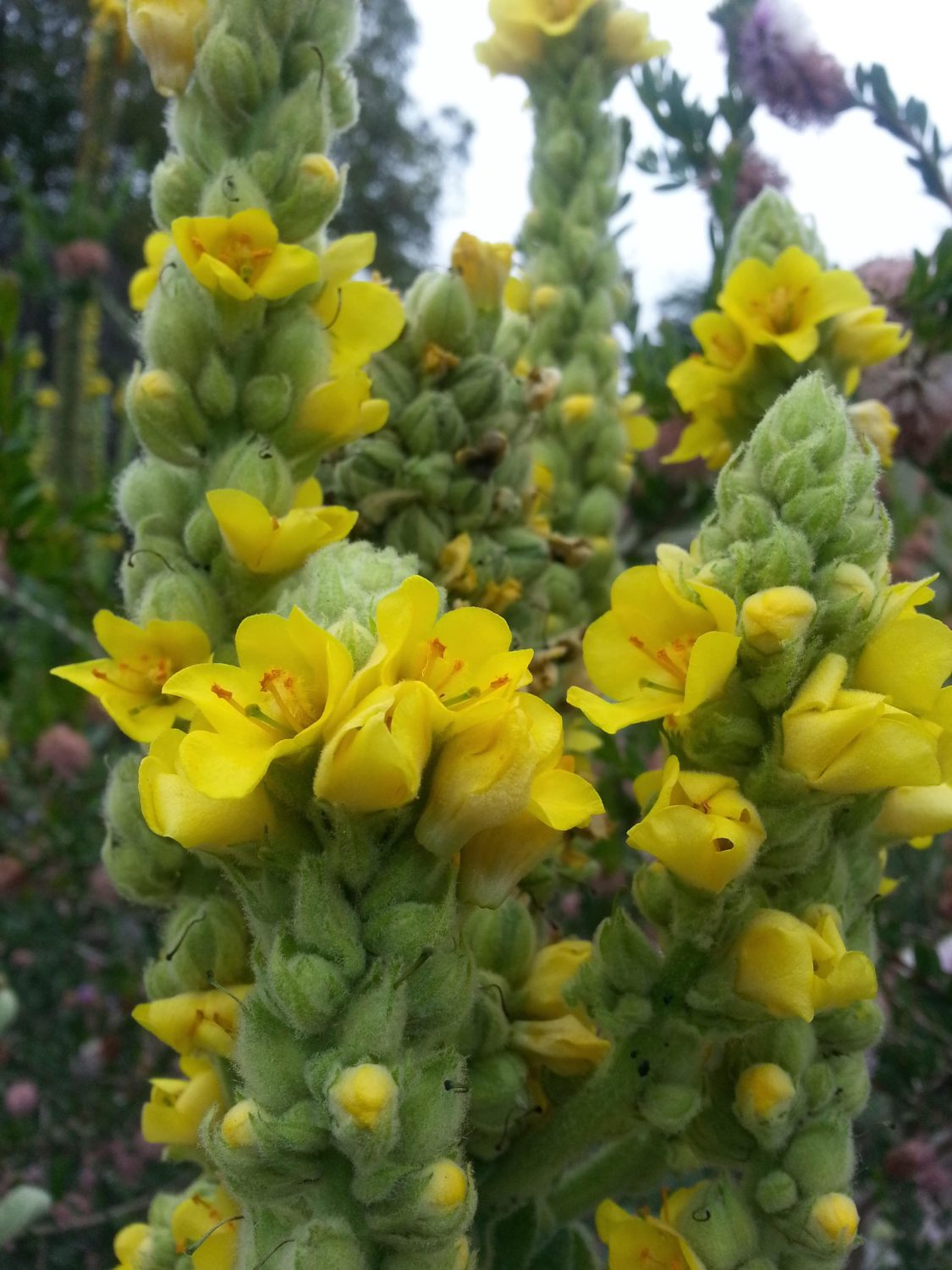
Mullein flowers (Verbascum thapsus)
Chamomile: A Remedy for Peaceful Sleep
Chamomile is an incredible plant with many healing benefits to the physical body and it also can aid with sleep and dreams. As a nervine, chamomile is very nourishing and relaxing to the nervous system and can be very useful to prevent and treat insomnia. Chamomile helps to relax the tension we hold in our physical bodies and, as I shared above, chamomile is particularly healing to the digestive system. If pain or stiffness or indigestion is keeping you awake at night, you might want to try drinking a cup of chamomile tea or taking a bath with it before bed.
Chamomile is also very healing to the emotions. It helps to relieve fear and anxiety that may be keeping us awake at night. In this case, the tea, tincture of chamomile might be helpful to take before going to sleep. Another suggestion is to make a dream pillow of chamomile of put a few drops of chamomile essential oil on your pillow so you are able to inhale the healing scent of the plant all night long. A chamomile bath is a lovely way to prepare for a good, peaceful night’s rest. Simply fill a muslin bag or an old clean sock with a handful of chamomile and add it to a hot bath. Relax, enjoy and soak in the medicine!
Chamomile is a great ally for alleviating nightmares for both adults and children. As a gentle, friendly and playful plant, chamomile has an affinity for helping children and chamomile is the first plant I think about to help children who are afflicted with nightmares. As adults, we may have enough understanding of dreams to work with our nightmares as a source of guidance and healing. In this case, chamomile can give us adults the courage to face and transform our frightening dreams. However, to a child, a scary dream monster may just be plain scary and nightmares can seriously interfere in their ability to sleep. I recommend making a dream pillow for the child and encourage them to be a part of the dream pillow making process. They can choose their favorite fabric, colors & patterns that make them feel safe and protected. However, working with chamomile in tea, tincture, flower essence or as a bath are all good ways to ease nightmares in both adults and children. I have recommended chamomile to many of my clients and students and often their nightmares stop after the first night of working with chamomile.
Practice Dreaming with Plants
If you are new to dreaming with plants, both mugwort and chamomile are good plants to start experimenting with. However, they are only two of many herbs that influence our dream state. Dream plants can be found in many cultures and I encourage you to research more about the dream plants of your ancestors. Also, I recommend that when you are learning about a new herbal ally that you also incorporate dreaming with the herb. Simply place the herb under your pillow or by your bedside. Talk to or meditate with the plant before going to sleep and ask it to show itself to you in your dreams. Keep a dream journal near your bed so you can record the messages from the plants that come in dreamtime.
Enjoy the practice of dreaming with plants and may the plants continue to bless your dreams with guidance, wisdom and healing!
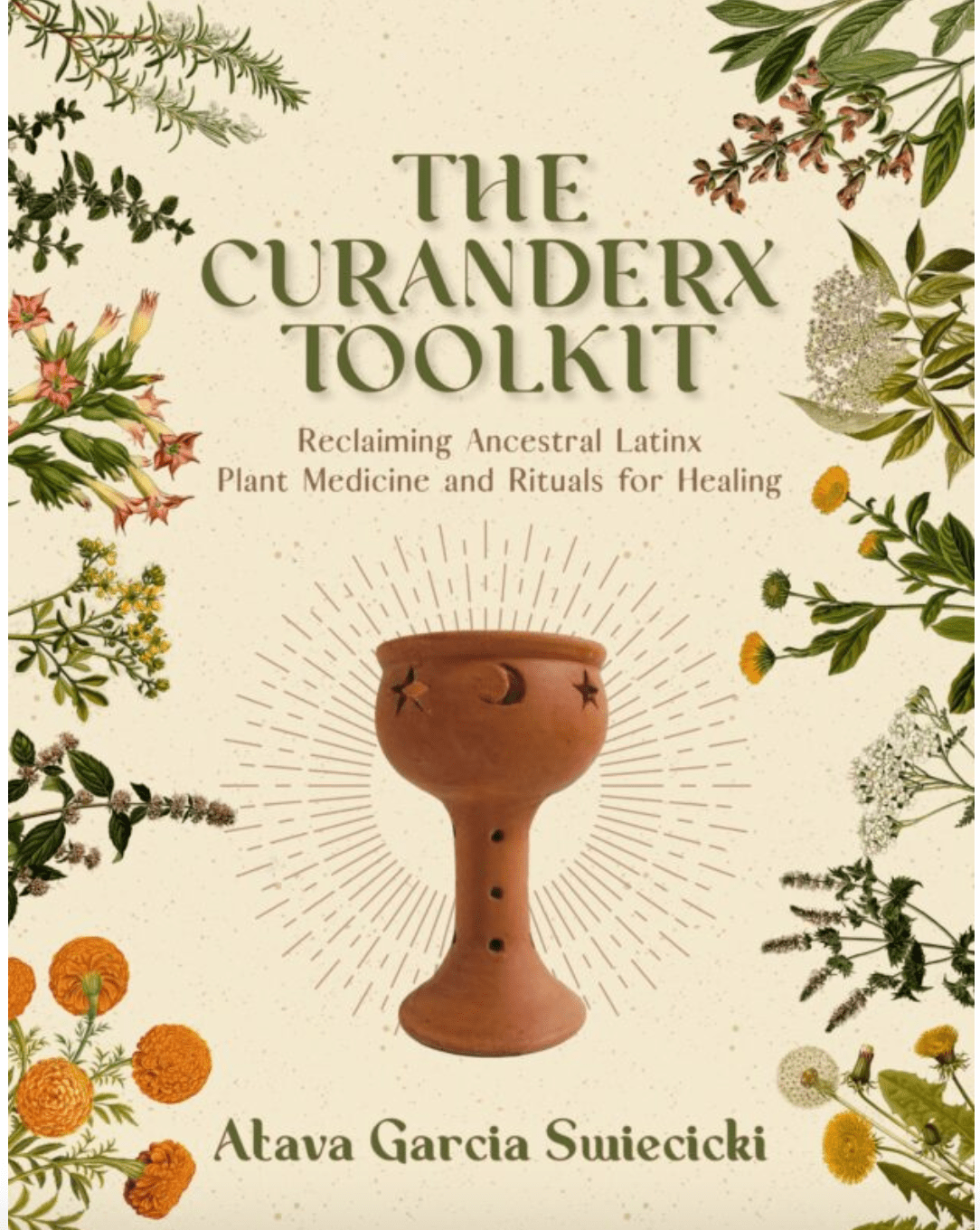
Read More in Atava’s Book: The Curanderx Toolkit
Arranging ofrendas. Brewing pericón into a healing tea. Releasing traumas through baños and limpias. Herbalist and curandera Atava Garcia Swiecicki spent decades gathering this traditional knowledge of curanderismo, Mexican folk healing, which had been marginalized as Chicanx and Latinx Americans assimilated to US culture. She teaches how to follow the path of the curandera, as she herself learned from apprenticing with Mexican curanderas, studying herbal texts, and listening to her ancestors. In this book readers will learn the Indigenous, African, and European roots of curanderismo. Atava also shares her personal journey as a healer and those of thirteen other inspirational curanderas serving their communities. She offers readers the tools to begin their own healing—for themselves, for their relationship with the earth, and for the people.
Endnotes
[i] Robin Wall Kimmerer, Braiding Sweetgrass: Indigenous Wisdom, Scientific Knowledge and the Teachings of Plants, (Minneapolis, MN: Milkweed Editions, 2013), 128
[ii] Greg Sarris, Mabel Mckay: Weaving the Dream, (Berkeley: University of California, 1994)


