
A Very Tasty New Mexican Mushroom
Gathered under pines,
I like to eat white boletes.
Free delicious food.
Ponderosa pines,
is where you’ll find these fungi.
Roast for nutty taste.
As September’s “Edible and Medicinal Mushrooms of New Mexico” class approaches, I’d like to feature one of my favorite edibles. Barrow’s bolete (Boletus barrowsii), aka white king bolete, is a cousin to the more famous king bolete (Boletus edulis) and the Rocky Mountain red-topped bolete (Boletus rubriceps). King bolete is European despite showing up in older North American guidebooks, while red toppers and Barrow’s boletes are specific to Western North America. Classification aside, all three are delectable.

Boletus barrowsii, photo by Maija Helt
Barrow’s bolete lives in a mycorrhizal association with ponderosa pines and, occasionally, with Douglas firs, which means heading to the mountains or high mesas to find them. Mycorrhizal mushrooms are those that grow linked to the roots of certain plants. They’re expensive to buy in markets because they’re foraged rather than cultivated. With few exceptions, mycorrhizal mushrooms (so far) can’t be cultivated due to specific growth conditions involving their plant partners, local soil microbes, and other factors.
Red toppers, in contrast, grow with Engelmann spruce higher in the mountains. Like red toppers, Barrow’s boletes are monsoon season mushrooms, popping up from July into September, depending on when the rains arrive and how long they last.
Barrow’s boletes are the same chunky shape and size as king boletes and red toppers. The cap grows up to 10 inches across, and the stalk is stout, often bulbous, making the mushroom resemble a Smurf house. The cap and stalk are pale, ranging from white to whitish-gray to light tan. The stalk might have pinkish tones and will have a slightly raised, net-like texture called “reticulation,” but will lack dark or otherwise colored scales. The underside of the cap sports a spongy layer of tubes from which the mushroom releases its spores (seeds of sorts). The spongy layer distinguishes Barrow’s bolete from the many white mushrooms having gills under the cap. The tube layer starts out white and firm, becoming yellow and spongier as the mushroom grows, finally turning olive-colored when the mushroom produces its olive-brown spores. The layer will not be orange or red. Slicing the mushroom in half should reveal white flesh with no blue or grayish bruising as seen with some (often toxic) bolete species.
Join Marija for Edible and Medicinal Mushrooms of New Mexico Live Online: September 6, 2025

Boletus barrowsii in Ponderosa duff, photo by Maija Helt
The size, shape, tube layer, and pale coloration make this a good mushroom for beginner foragers, but it’s still mandatory to be absolutely certain on mushroom identification before eating any wild mushroom. If it’s your first time picking the mushroom, reach out to the New Mexico Mycological Society to confirm ID. (Stay tuned for a possible spring class on wild mushroom identification.) Be aware that fly agaric (Amanita muscaria) can fade to near-white in the sun, and you don’t want to mistake it for a bolete. Fly agaric has gills rather than a spongy tube layer, has a ring around the stalk (though this can wear away with weather), and it typically (but not always) grows at higher elevation in association with Engelmann spruce.
In terms of medicine, I’ve not yet come across information specifically on Barrow’s bolete. But people in Eastern Europe use the closely related king bolete for upset stomach, angina, and other health challenges. In Traditional Chinese Medicine king boletes are a component of “tension easing pills”, a treatment for low back pain, discomfort in the legs—especially related to tendons—and other issues. Boletes are high in beta-glucans, a type of soluble dietary fiber with multiple beneficial effects on the immune system, and selenium, which supports thyroid and immune function. However, king boletes are reportedly accumulate heavy metals such as cadmium and mercury from contaminated soils. Be sure to go bolete hunting well away from active or defunct mines and don’t treat them like a staple food that’s eaten frequently and in large quantities.
One of my favorite ways to prepare Barrow’s boletes (and red toppers) is to make roasted bolete chips that can be enjoyed as is; added to soups, stews, or risotto; powdered as a base for sauces or gravy, a rub for steak or pork, or a seasoning for roasted veggies. When an herbalist friend visited, we rimmed our margarita glasses with roasted bolete powder, alder-smoked salt, and New Mexican red chile powder. Delicious!
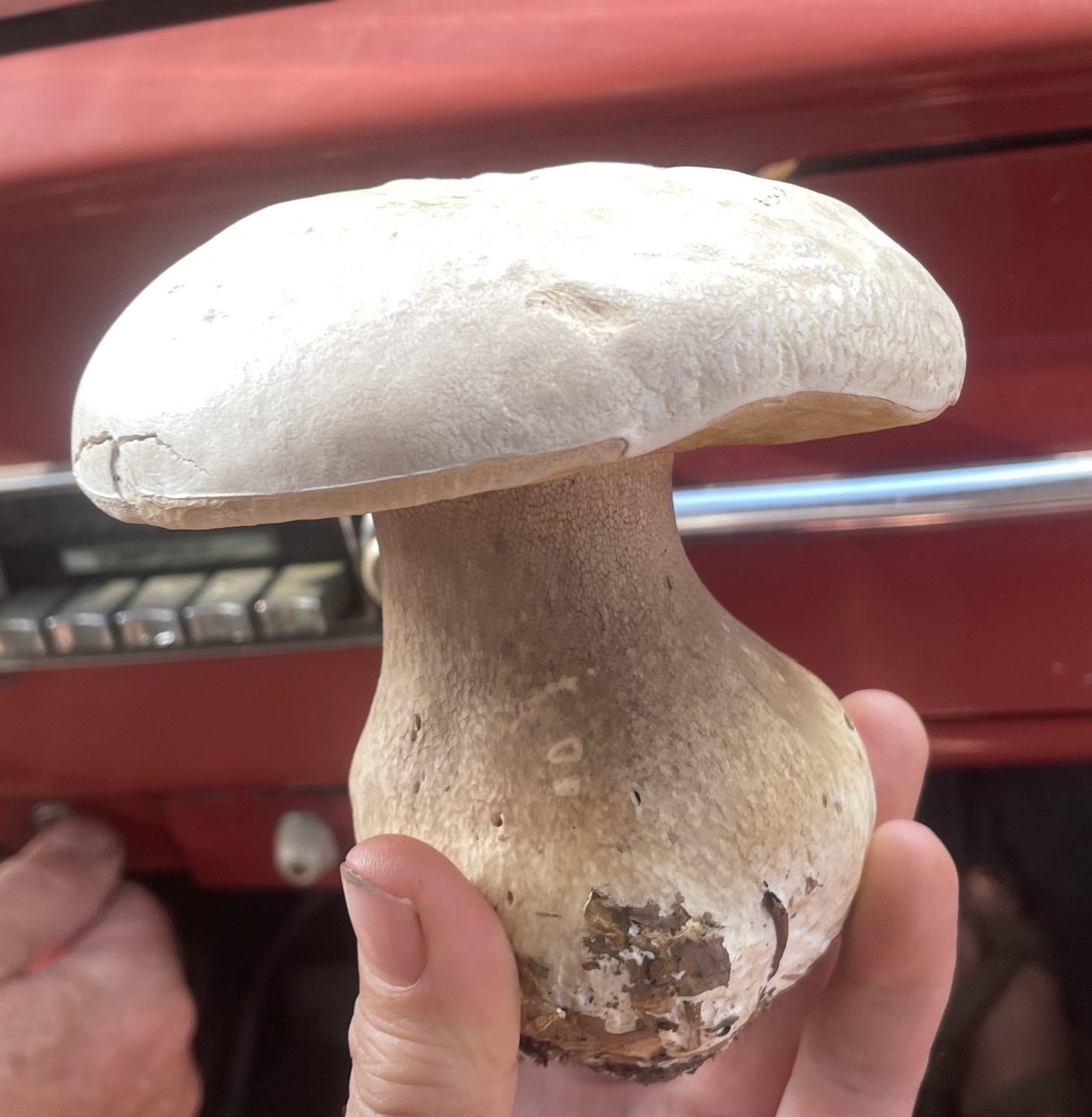
photo by Maija Helt
Preparing dry-roasted bolete chips
- In the field, remove dirt and debris with a brush and slice off any stubborn dirt on the stalk (you’ll see what I mean).
- Once home, you can store boletes in the fridge for a day or two in a glass bowl covered with a wet paper towel. But I recommend preparing them the same day because any resident larvae will happily continue to eat your mushrooms while they’re in the fridge.
A word on larvae (tiny worms) – They’re harmless. And common, especially the larger the bolete. I freaked out with the first bolete I ever harvested because it had a few larvae in it. Such a waste. (Now, as long as there’s more mushroom than larvae, I’m good.) Before collecting a bolete, feel the cap and stalk. They should be firm. If either is soft, leave it for the larvae to finish off.
- Use a soft brush or paper towel to further clean the mushrooms. I usually don’t wash them, but you can give them a quick rinse if desired.
- Separate the stalk and cap and cut the cap in even slices about 1/4 inch thick. Peel off the tube layer, which can also be roasted but it cooks faster. If the cap is large, cut the slices to half or a quarter of their length. Slice the stalk similarly.
- Place the slices in a single layer on cookie trays or other type of baking sheet and sprinkle lightly with salt. Place trays in an oven preheated to 200°F. To prevent the slices from sticking, very lightly grease the sheet, keeping in mind that the goal is to dry roast, not to cook in oil.
- After ~20 minutes, as the slices start shrinking, flip them with a metal spatula. As the slices begin to brown, move them around with the spatula and begin checking every 10 minutes to remove those that are dry, or nearly dry, before they burn.
- Once all the slices are dry roasted, let them cool, make sure they’re completely dried, and store in a glass jar with the lid on tight. They’ll be good for 2-3 years if stored away from heat and light.
Boletes are high in fiber. If you don’t typically eat a high-fiber diet, don’t gorge yourself on the mushrooms or you’ll be spending some extra time in the bathroom. Also, if you’re new to this mushroom, start out by eating just a little bit. As with other foods, idiosyncratic reactions to mushrooms are possible. While I’ve had no problem combining a bolete-themed meal with alcohol, there are rare cases where the combination has caused digestive distress.
References + Further Reading
Cripps, Cathy L, et al (2016) The Essential Guide to Rocky Mountain Mushrooms by Habitat. University of Illinois Press, Chicago, IL.
Hobbs, Christopher (1986) Medicinal Mushrooms: An Exploration of Tradition, Healing, and Culture. Botanica Press. Summertown, TN.
North American Mycological Association. Mushroom Poisoning Syndromes.
Santa Fe Botanical Garden – entry for Pinus ponderosa.
States, Jack S (1990) Mushrooms and Truffles of the Southwest. University of Arizona Press, Tucson, AZ.
Stucky Evenson, Vera (2015) Mushrooms of the Rocky Mountain Region: Colorado, New Mexico, Utah, Wyoming. Timber Press, Portland, OR.
Dr. Anna Marija Helt is an herbalist based in Durango, Colorado. She offers in person and online herbal consultations for health. She can be contacted at Osadha Natural Health for inquiries.
This article is for educational purposes only and is not meant to diagnose or treat a disease, or to supplant the advice of a licensed health care provider.


